
Find Unclaimed Money in Fountain County
Unclaimed money in Fountain County is held by the Indiana Attorney General's Unclaimed Property Division until the owner claims it. The state gathers dormant bank accounts, uncashed checks, forgotten insurance proceeds, utility deposits, and other financial assets from Covington and all of Fountain County. The search costs nothing. There is no charge to look up your name to file a claim. If you have ever lived or worked in Fountain County, take a few minutes to check the state's database.
Fountain County Quick Facts
Indiana Unclaimed Money in Fountain County
The Indiana Attorney General's Unclaimed Property Division holds more than $914 million spread across approximately 5.1 million accounts statewide. About one in seven Hoosiers has unclaimed money in that system. Fountain County is a small, rural county in western Indiana, centered on Covington near the Illinois border. Residents here are just as likely as those in larger Indiana counties to have dormant bank accounts, forgotten paychecks, or uncollected insurance proceeds sitting in state custody with their name on them.
Under IC 32-34-1-19, businesses and financial institutions must turn dormant assets over to the state after a dormancy period of three to five years of no owner contact. Once the state holds the property under IC 32-34-1-30, the owner's right to claim it never expires. There is no window that closes. You can file a claim years or even decades after the property was reported, and the full amount will still be there waiting for you.
Search the free database at indianaunclaimed.gov, which is maintained by the Attorney General and covers all 92 Indiana counties. The state pays out more than $1 million to verified owners every week.
Note: Searching under maiden names, former business names, and names of deceased relatives can turn up additional property that a simple name search alone would miss.
Fountain County Treasurer's Office
The Fountain County Treasurer is Tiffany Wells. The office is located in Covington on 4th Street. The treasurer handles property tax collections, local tax sales, and Fountain County government financial operations. This office is not part of the Indiana Attorney General's unclaimed property program. Banks, insurers, and employers do not send dormant accounts to the county treasurer; they send them to the state. The treasurer's office is the appropriate contact if you believe Fountain County owes you a direct refund, such as an overpaid property tax, a returned check, or another county-issued payment that was never collected.
For everything else, the right place to search is indianaunclaimed.gov. The Fountain County website at fountaincounty.net has general contact information for all county offices and departments.
| Name | Tiffany Wells, Fountain County Treasurer |
|---|---|
| Address | 301 4th Street, Covington, IN 47932 |
| Phone | (765) 793-6226 |
| Fax | (765) 793-5027 |
| County Website | fountaincounty.net |
| Treasurer Website | treasurer.fountaincounty23.us |
How to Search Fountain County Unclaimed Money
The search takes only a few steps. Go to indianaunclaimed.gov/app/claim-search and type in your last name. Adding a first name helps narrow the results. The database covers all Indiana counties, so property linked to any past Fountain County address will appear in your results. Former Covington residents who have moved elsewhere in Indiana or out of state can still search and claim property tied to their old Fountain County address.
The Fountain County Treasurer's website shown here covers local financial services and tax matters for Covington-area residents and property owners at treasurer.fountaincounty23.us.
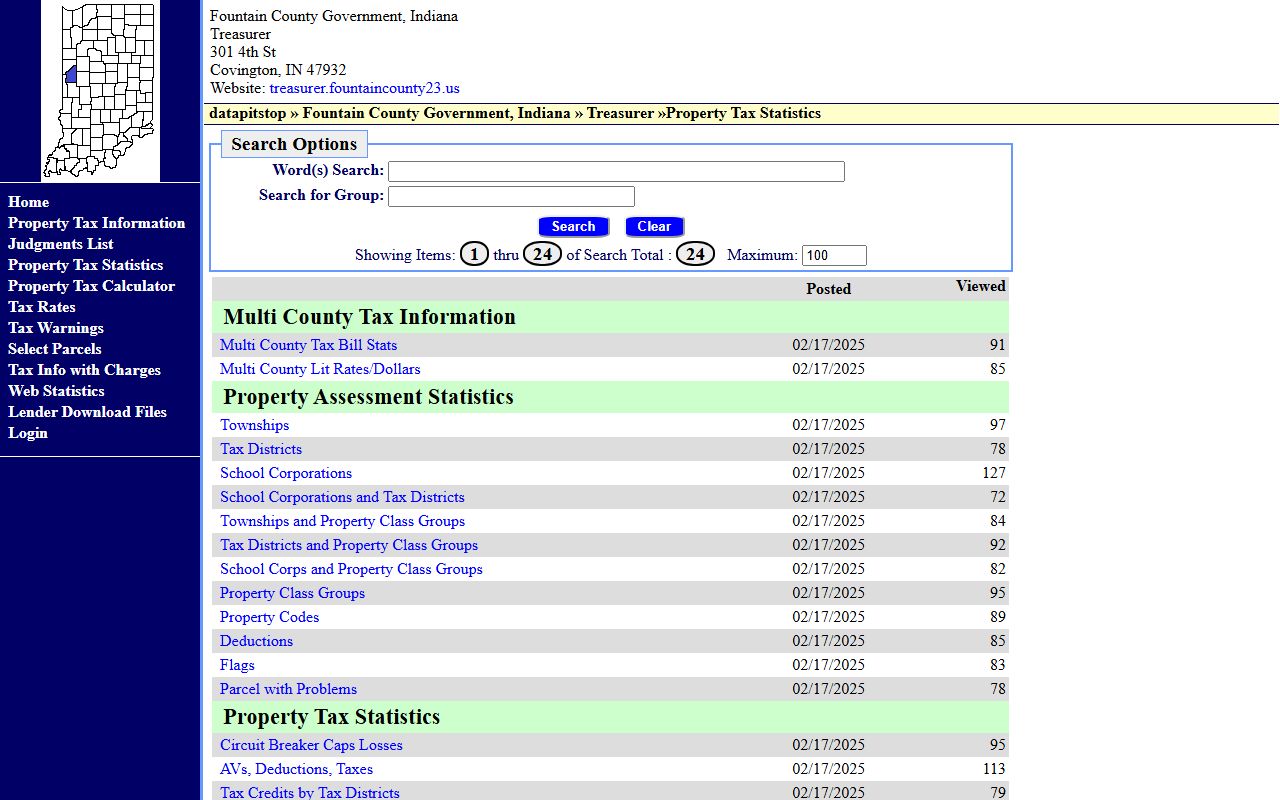
The treasurer's site at treasurer.fountaincounty23.us provides information on local tax payments and county financial office contacts for Fountain County residents.
Once you find a matching record in the state search, click the claim button and follow the online steps. For questions, call 1-866-IN-CLAIM (1-866-462-5246) or send an email to updmail@atg.in.gov. Most claims can be completed entirely online without any printing or mailing.
What Counts as Unclaimed Money
Indiana's unclaimed property program covers a broad range of financial asset types. Under IC 32-34-1-1, any financial asset where the holder has lost contact with the owner for the applicable dormancy period becomes unclaimed property. For Fountain County residents, that might mean a savings account at a Covington bank, a checking account at a rural credit union, or a CD from a financial institution that has since closed or merged.
The types covered go well beyond bank accounts. Uncollected wages and final paychecks from former employers, stock dividends and mutual fund distributions, insurance policy proceeds, security and utility deposits, money orders, retail store credit balances, and safe deposit box contents all qualify. The typical unclaimed account in Indiana holds less than $100, but the database also contains much larger amounts. The highest single claim ever paid in Indiana reached $750,000. Small claims and large ones all go through the same free process, and the full amount is paid out to the verified owner without any deductions.
Note: Businesses that hold dormant financial assets must report them to the state each year under IC 32-34-1-26. That is what populates the state's searchable database for Indiana residents.
Claiming Your Fountain County Property
The claim process is free. Do not pay a third party to file for you. The state returns the full amount it holds in your name, with nothing withheld.
Here is what to do as a Fountain County resident:
- Go to indianaunclaimed.gov and search your name
- Find and select the matching property record
- Complete the online claim form with your current contact information
- Upload any supporting documents the state requests
- Wait for the Attorney General's office to verify and approve your claim
- Receive your payment by check or direct deposit
Documents required depend on the claim amount and type. Small claims typically need only a government-issued photo ID. Larger claims may require a utility bill, bank statement, or other proof linking you to the account. Claims on behalf of a deceased person require a death certificate and documents proving your legal relationship and authority, such as a will, letters of administration, or court-issued documents from a probate proceeding. The Attorney General's office reviews each claim before payment and will notify you if additional information is needed.
Search Multiple States for Unclaimed Property
Fountain County lies in western Indiana, not far from the Illinois border. If you have ever lived or worked in Illinois or another state, those states may hold unclaimed money in your name that Indiana's system would not capture. MissingMoney.com is the official multi-state search portal endorsed by the National Association of Unclaimed Property Administrators. A search at missingmoney.com covers Indiana and dozens of other participating states at once.
The Indiana Attorney General's unclaimed property search portal is shown below. This is the primary tool for all Fountain County unclaimed money held at the state level at indianaunclaimed.gov.

The free search at indianaunclaimed.gov covers all property reported to Indiana by any holder, from any industry, across all 92 counties including Fountain County.
Use indianaunclaimed.gov for Indiana-specific searches and MissingMoney.com for a broader sweep. Fountain County residents who have ties to Illinois should also search Illinois's unclaimed property program. All searches are free and require no registration to view results.
Cities in Fountain County
Fountain County includes Covington as the county seat, along with smaller communities such as Attica, Veedersburg, and Fountain. None of the cities in Fountain County currently meet the population threshold for a dedicated city page on this site. All residents throughout the county can search for unclaimed money using the free state tool at indianaunclaimed.gov.
Nearby Counties
Fountain County borders several Indiana counties. If you have lived near a county line or held financial accounts in a neighboring area, check those counties as well.